
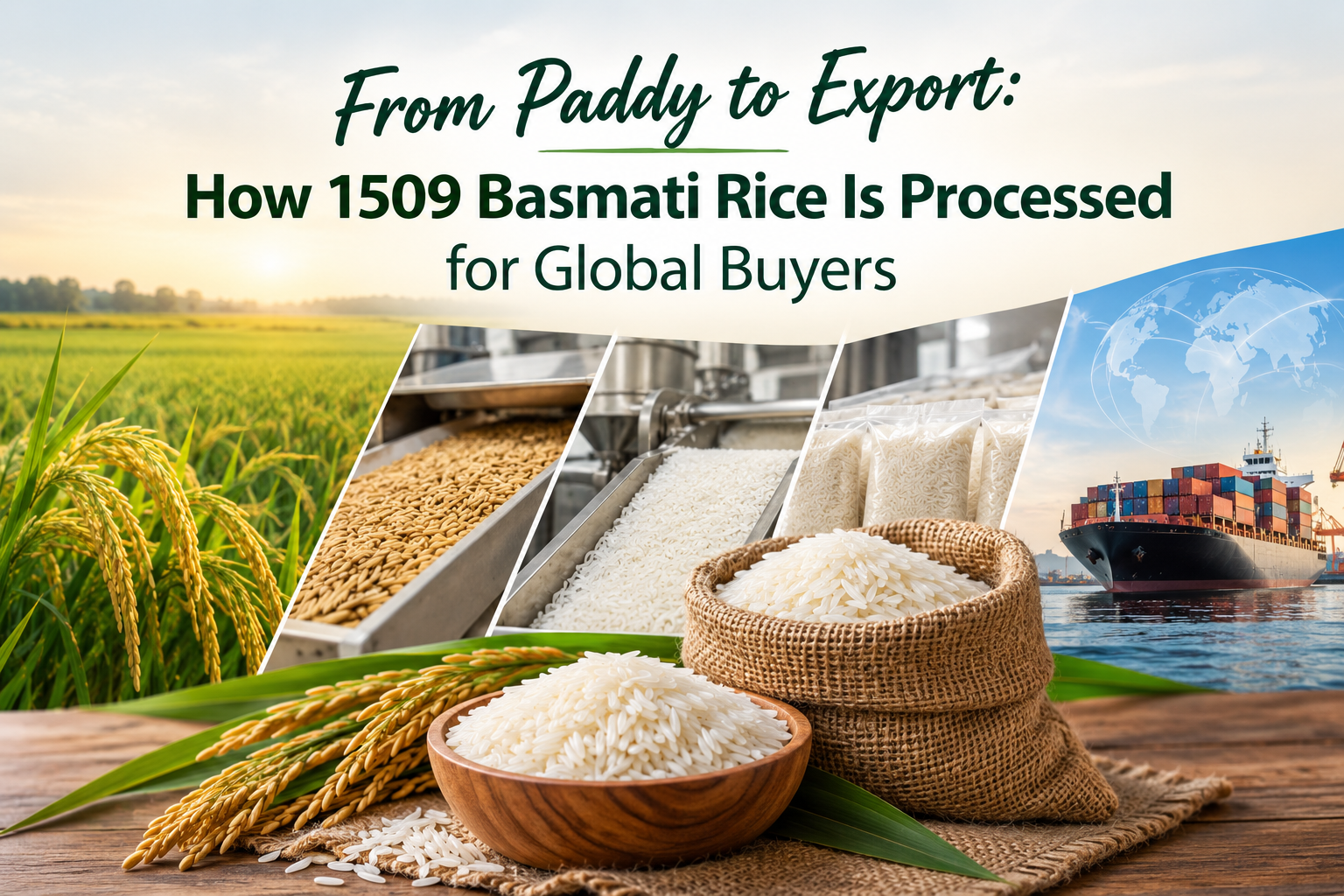
While buying 1509 Basmati Rice internationally, there are many considerations for rice buyers that go beyond the long grains and aromatic properties of rice. These include the selection of the paddy, proper processing, milling, grading, sorting, and inspecting of quality. At Shree Krishna Exports, all the processes affect the length of grains, quality of grains, and performance.
Being a professional manufacturer and exporter of 1509 Basmati Rice, it is very important to maintain control during all of these processes.
1. Selecting Quality 1509 Basmati Paddy
The process of 1509 Basmati Rice involves selection of proper paddy.
Pre-milling inspection of the raw material involves assessment of moisture content, nature of grains, purity, immature grains, foreign materials, and consistency.
Proper raw material is essential to achieve higher milling recovery and minimize grain breakages. In case of production for exports, quality assurance commences before the paddy enters the milling process.
2. Cleaning and Conditioning the Paddy
Contamination in terms of dirt, stones, straw, and metal objects may be present in freshly harvested paddy. The removal of these is carried out through multi-stage processes prior to dehusking and milling.
Conditioning and proper moisture management are equally essential. This is because moisture control will aid in strengthening the grains and reducing breakage during the milling process.
3. Precision Milling for Export-Quality Rice
The cleaned paddy is processed by dehusking and milling operations, which help in the removal of the husk and bran layers from it. Modern milling techniques are developed to mill to the desired extent without damaging the grains.
The important quality parameters are recovery of head rice, percentage of broken grains, length of the grain, chalkiness, whiteness, and grain uniformity. These are highly essential, especially for export of 1509 Basmati Rice.
4. Different Types of 1509 Basmati Rice
The processing methods give distinct properties to the various varieties of 1509 Basmati that are provided to both local and foreign buyers.
- 1509 White Basmati Rice: It goes through processing by which a clear white appearance is achieved while preserving the unique long-grain and aromatic properties of the Basmati rice.
- 1509 Steam Basmati Rice: It has been processed by controlled steaming prior to its milling. The controlled steaming process helps to strengthen the grains, separate them, and cook them consistently.
- 1509 Sella Basmati Rice: It has been processed using a controlled parboiling and drying process. The parboiling and drying process helps to strengthen the grains and provides distinct characteristics when cooked.
- 1509 Golden Sella Basmati Rice: It is processed by controlled parboiling and drying, which gives the grains their distinct golden color.
5. Grading, Sorting and Quality Control
Rice is sorted on the basis of size and quality after it has been milled. Optical sorting machines can separate any discoloration or damaged grains. Quality testing includes checking the moisture level, broken rice, foreign material, size, appearance, and other factors as required by the customer.
6. Packaging for International Rice Buyers
After ensuring that the rice meets the required standards, it is packaged in accordance with the needs of the customers and destinations. Proper packaging ensures that the product remains safe during both storage and transportation.
Preparation for export also requires proper documentation and preparation of shipments.
Conclusion
The process of ensuring uniformity in the production of 1509 Basmati Rice involves selecting the right paddy, regulating moisture content, precise milling, grading, sorting, and packaging. We provide 1509 White, Steam, Sella, and Golden Sella Basmati Rice to local and foreign customers. Through quality-oriented production and uniform specifications, we assist importers, distributors, wholesalers, and the food industry.