
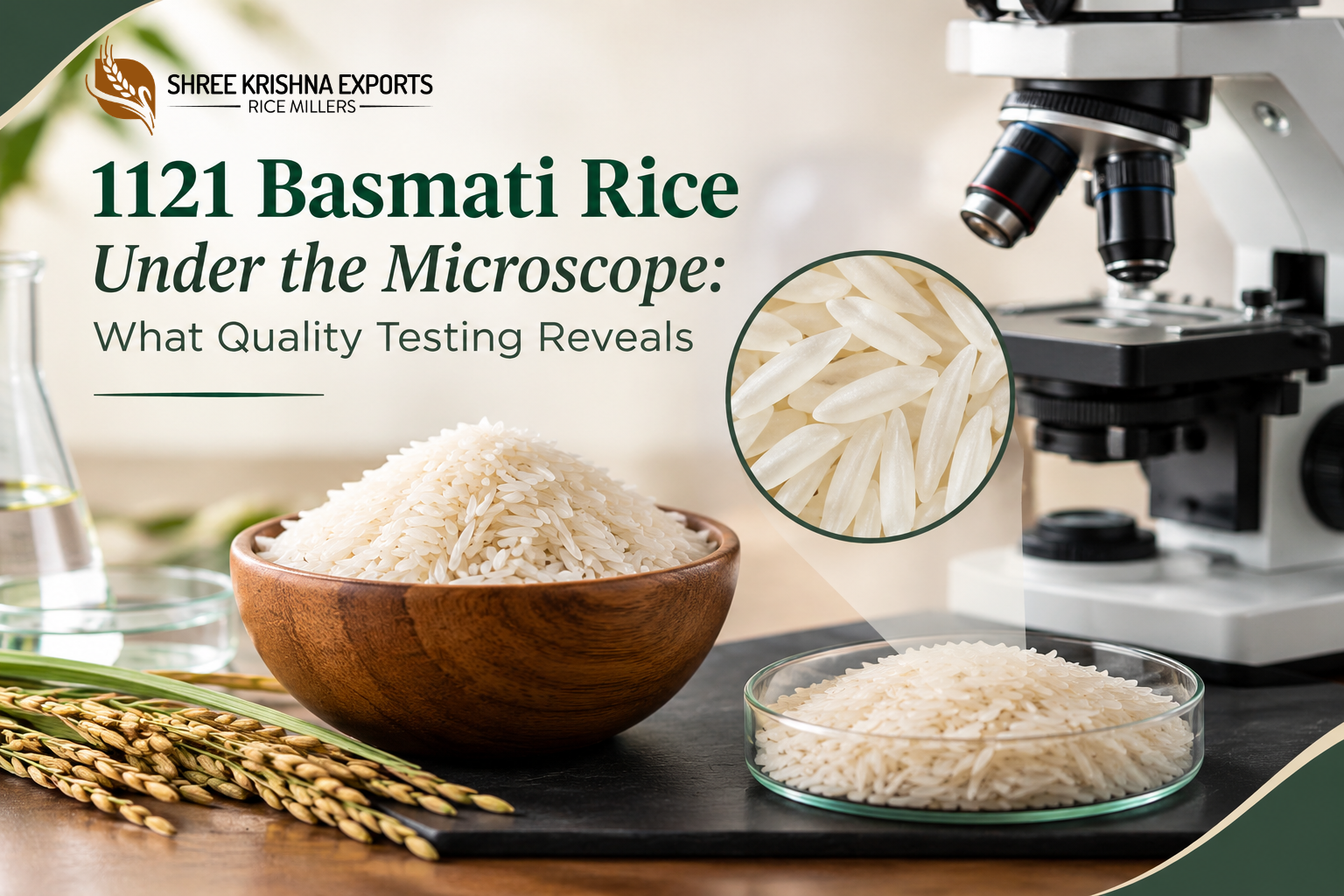
Though a long & slender grain may instantly give an impression of a good Basmati variety of rice, appearance alone does not speak to the total quality of the rice grain. In the case of the 1121 Basmati variety, there are many factors that assume significance, viz. grain uniformity, chalkiness, cracks, damage, and endosperm nature.
In order to offer a comprehensive assessment of rice quality, Shree Krishna Exports also offers information on grain quality parameters along with conventional parameters like moisture content, broken ratio, purity & cooking elongation.
Quick facts buyers should know about 1121 Basmati Rice:
- Raw grain length: Approximately 8.2–8.4 mm, depending on grade and specification.
- Cooking elongation: Quality 1121 grains can expand to around 20–22 mm after cooking.
- Moisture: Commercial specifications commonly target around 12–13%.
- Broken grains: Premium grades may specify approximately 0.5–1% broken grains.
- Ageing: Old Basmati rice is aged between 12-24 months.
- Grown areas: Haryana, Punjab, and Uttar Pradesh are major producers of Basmati.
- Market forms: 1121 rice is marketed in White, Steam, Sella, and Golden Sella Basmati rice varieties.
What Can Be Revealed Under Closer Grain Inspection?
A microscopic examination can help identify those characteristics that may not always be obvious during ordinary visual inspection.
| Grain-Level Factor | What Quality Inspection Can Reveal | Why It Matters |
| Kernel structure | Uniformity and appearance of the rice endosperm | Indicates consistency of individual grains |
| Chalkiness | Opaque or white areas within the kernel | Excessive chalkiness can affect appearance and grading |
| Fissures and cracks | Fine internal or surface cracks | Can increase the possibility of breakage during milling |
| Discolouration | Abnormal patches or colour variation | May indicate damaged or defective grains |
| Insect or mechanical damage | Small damaged areas or surface defects | Helps identify grains unsuitable for premium grades |
| Grain uniformity | Differences in size, shape, and structure | Important for consistent appearance and cooking |
| Surface cleanliness | Remaining bran, impurities, or foreign particles | Supports purity and finished-product quality |
1. Looking at the Grain Structure
The internal structure of the rice kernel is made up mainly of starchy endosperm, surrounded by layers on the outside that are stripped off through milling.
It becomes significant in the case of high-quality 1121 Basmati rice because there are considerable variations among individual grains.
2. Fissures Can Explain Grain Breakage
Some grain defects are difficult to identify from a quick visual inspection. Fine cracks or fissures within the kernel can become particularly important during milling. Controlling drying, handling, storage, and milling conditions therefore plays an important role in maintaining whole-grain recovery.
3. What Happens After Cooking?
Micron structure is just one aspect of quality evaluation. In the end, the consumer also needs to be sure about the performance of the rice in the kitchen.
A high-quality 1121 Basmati exhibits high longitudinal expansion, growing to around 20-22 mm during the cooking process under optimal conditions. Grain separation, texture, flavor, and structure are other vital factors.
Technical Specifications Buyers Should Check
For bulk procurement, grain-level inspection should be combined with measurable specifications such as:
- Grain length and uniformity
- Moisture content
- Broken grain percentage
- Purity and foreign matter
- Chalky and damaged grains
- Processing type
- Ageing period
- Cooking elongation
- Packaging and destination-market requirements
For 1121 White Basmati Rice, 1121 Golden Sella Basmati Rice, 1121 Steam Basmati Rice and 1121 Sella Basmati Rice, the applicable specifications can differ according to processing method and buyer requirements.
Best 1121 Basmati Rice – Shree Krishna Exports
The quality of basmati rice is determined through many levels of inspection, not just through the inspection of grain length. Grain selection and cleaning, milling, grading, sorting, and inspecting are all processes that can affect the end product.
In evaluating the 1121 Basmati Rice in bulk for purchase, it would be helpful to look at both the specifications and the grains themselves.
Frequently Asked Questions:
1. What can microscopic examination determine about Basmati Rice?
It might be able to distinguish factors like chalkiness, fissures, damage, color changes, and structural variations that could not be evident through ordinary examination.
2. Why is fissure crucial for 1121 Basmati Rice?
Internal fissures might render the grains more liable to breaking during processing.
3. What specifications are necessary for buying 1121 Basmati Rice?
Some critical considerations include grain length, moisture content, percentage of broken grains, purity, chalkiness, damaged grains, aging, method of processing, and elongation after cooking.