
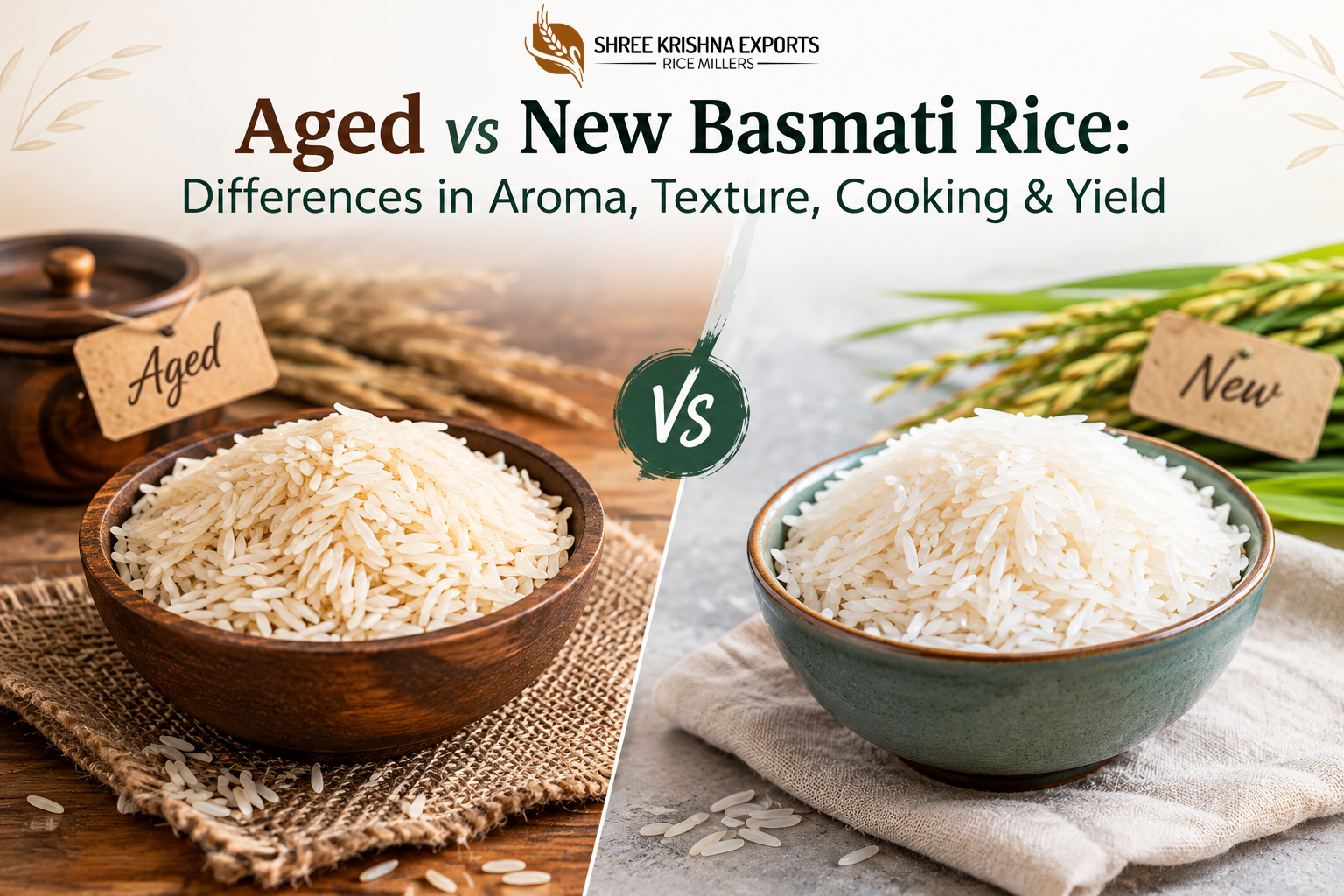
The distinctive aroma, long grains, and cooking quality are some of the unique features that give basmati rice its popularity. It should be noted that the age of the rice after it has been harvested may greatly affect the mentioned features. For customers who are buying from Basmati rice suppliers in Haryana, we at Shree Krishna Exports want to make you aware of the significance of the difference between old and new harvests.
What Is Aged Basmati Rice?
Mature Basmati rice is kept in controlled environments for a specific amount of time prior to milling and distribution. During the aging process, there are some physical and chemical changes that take place within the rice kernels.
Aged rice generally offers:
- More pronounced natural aroma
- Firmer grain texture after cooking
- Better grain elongation
- Lower tendency to become sticky
- Improved water absorption and cooking consistency
This makes aged Basmati particularly suitable for premium retail, restaurants, catering, and export markets.
What Is New Basmati Rice?
Basmati Rice in Haryana, are the new Basmati rice refers to rice produced from a recent harvest with comparatively limited aging. It generally contains higher moisture and has not undergone the same storage-related changes as aged rice.
Depending on the variety and processing conditions, new rice may provide:
- Softer cooked texture
- Fresh grain characteristics
- Different aroma intensity
- Relatively shorter cooking time
- Greater variation in cooking performance
The choice between new and aged rice therefore depends on the intended application, buyer requirements, and desired cooking results.
Aged vs New Basmati Rice: Key Differences
| Parameter | Aged Basmati Rice | New Basmati Rice |
| Aroma | More developed and pronounced | Relatively fresh |
| Texture | Firmer and more separated | Softer |
| Grain elongation | Generally higher | Comparatively lower |
| Stickiness | Lower tendency | Can be relatively higher |
| Water absorption | More controlled | Can vary |
| Cooking consistency | Generally better | Depends on variety and processing |
| Typical applications | Premium/export/foodservice | Domestic and general consumption |
How Aging Affects Cooking & Yield?
Another benefit of correctly stored Basmati is the cooking quality. During storage, there occurs a series of structural changes within the grain that will enhance water uptake and prevent breakages in the process of cooking.
The yield for the buyer, therefore, cannot be calculated in terms of raw rice only. Parameters like elongation, cooked volume, breakage percentage, moisture, milling quality, and cooking losses may affect the yield of usable product.
This is why professional Basmati rice producers consider both laboratory specifications and cooking quality before making bulk deliveries.
Which Basmati Rice Should You Choose?
A choice does not always have to be made for all applications. Aged Basmati is the option chosen where long-grain appearance, aroma, separation, and good cooking behavior are important considerations. The New Basmati may be appropriate where fresh grain attributes and particular cooking qualities are desired.
When considering wholesaling, restaurant, distribution, or overseas markets, there are Basmati Rice Wholesalers in India need to be considered that need to be taken into account together.
Conclusion
The choice of rice is not just the choice between old and fresh grains. In addition to this, the issues of consistent sourcing, proper processing, grading, and checking of quality become equally relevant. All these aspects have been taken into consideration by Shree Krishna Export Rice Mill to assist in buying Basmati rice from manufacturers in Haryana.
If you are a wholesaler, distributor, or institutional buyer, the choice of rice according to certain specifications and usage requirements will bring more consistency in every batch.
Frequently Asked Questions:
1. How long should Basmati rice be aged?
Premium Basmati rice is commonly aged for several months to improve aroma, grain texture, and cooking performance. The ideal period depends on the variety and storage conditions.
2. Does aged Basmati rice have better cooking yield?
Properly aged Basmati can deliver better grain elongation, separation and volume expansion, potentially improving the usable cooked-rice yield per kilogram.
3. How can buyers check the quality of Basmati rice?
Buyers should evaluate grain length, moisture, broken percentage, milling recovery, aroma, purity, and cooking performance before placing bulk orders.
4. Why is aged Basmati rice preferred by export markets?
Aged Basmati is often preferred for its consistent cooking behaviour, pronounced aroma, grain elongation, and firm, separate texture—important characteristics for foodservice and international markets.